
If you drive an electric vehicle in Sonoma County and you’re facing a collision repair right now, the bill is going to look different than what your gas-powered neighbor pays down the street. EV auto body repair claims averaged $6,042 in Q1 2026 according to Mitchell’s collision data, compared to $4,902 for a standard gasoline vehicle, and calibration work is one of the biggest reasons for that gap.
It’s not just the battery pack or the aluminum body panels driving that number up. Every camera, radar unit, and parking sensor on a modern EV has to be recalibrated to millimeter-level accuracy before the car leaves our shop, and that process adds time, equipment, and expertise that a standard fender-bender repair never required.
Key Takeaways
- EV auto body repair costs more upfront: the average BEV claim runs about 23 percent higher than a comparable gas vehicle claim, largely due to calibration and OEM parts requirements.
- Calibrations are now routine, not rare: 28.3 percent of repairable estimates required at least one calibration in 2026, up from 21.8 percent the year before.
- Battery-equipped vehicles average 1.70 calibrations per repair estimate, higher than the 1.54 average for internal combustion vehicles.
- Not every shop can do this work in-house. The equipment and training investment is steep, and drivers should confirm a shop’s calibration capabilities before dropping off their EV.
- OEM parts matter more on EVs. Roughly 86 percent of parts dollars on BEV estimates go toward OEM components, compared to 62 percent for ICE vehicles, because aftermarket parts often can’t be calibrated reliably.
- Structural materials complicate repairs. Learn more about why hybrid and battery-equipped vehicles cost more to fix than a traditional gas car.
- Does my EV need a calibration after a minor fender repair? Often, yes. If the bumper, windshield, or a wheel is touched during EV auto body repair, the sensors mounted to those components typically need to be reset and verified.
Why EV Auto Body Repair Requires More Calibrations Than Ever
Ten years ago, a bumper repair meant matching paint and making sure the panel gap looked right. Today, that same bumper likely houses a radar sensor, a parking camera, or both.
When you bring an EV in for auto body repair, we’re not just restoring the sheet metal to its pre-accident condition. We’re also verifying that every sensor tied to that panel still reads the world around the car correctly.
That front-facing camera behind the windshield, the radar unit tucked into the front fascia, the ultrasonic sensors lining the bumpers: all of them depend on precise physical alignment. Move any of them even a few millimeters during a repair, and the vehicle’s collision-avoidance systems can misjudge distance, misread lane position, or fail to activate at all.
The ADAS and Battery Safety Systems Behind Every Calibration
Advanced driver-assistance systems (ADAS) are standard equipment on nearly every EV sold in 2026, and they’re the primary reason calibration has become a routine part of the repair process rather than an occasional add-on.
When a technician disconnects, removes, or even shifts a component near one of these sensors, the calibration data stored in that sensor’s memory can become invalid. The vehicle doesn’t know it’s misaligned; it just reports what it “sees,” and if that data is wrong, the driver assistance features respond incorrectly.
Battery safety adds another layer. High-voltage systems require technicians trained specifically in EV disconnect procedures before any bodywork begins, because working around a live battery pack without the right protocol is dangerous for everyone in the shop. Safety remains paramount at every stage of this process, from the first inspection to the final calibration check.
Structural Materials and Floorpan Repairs in EV Auto Body Repair

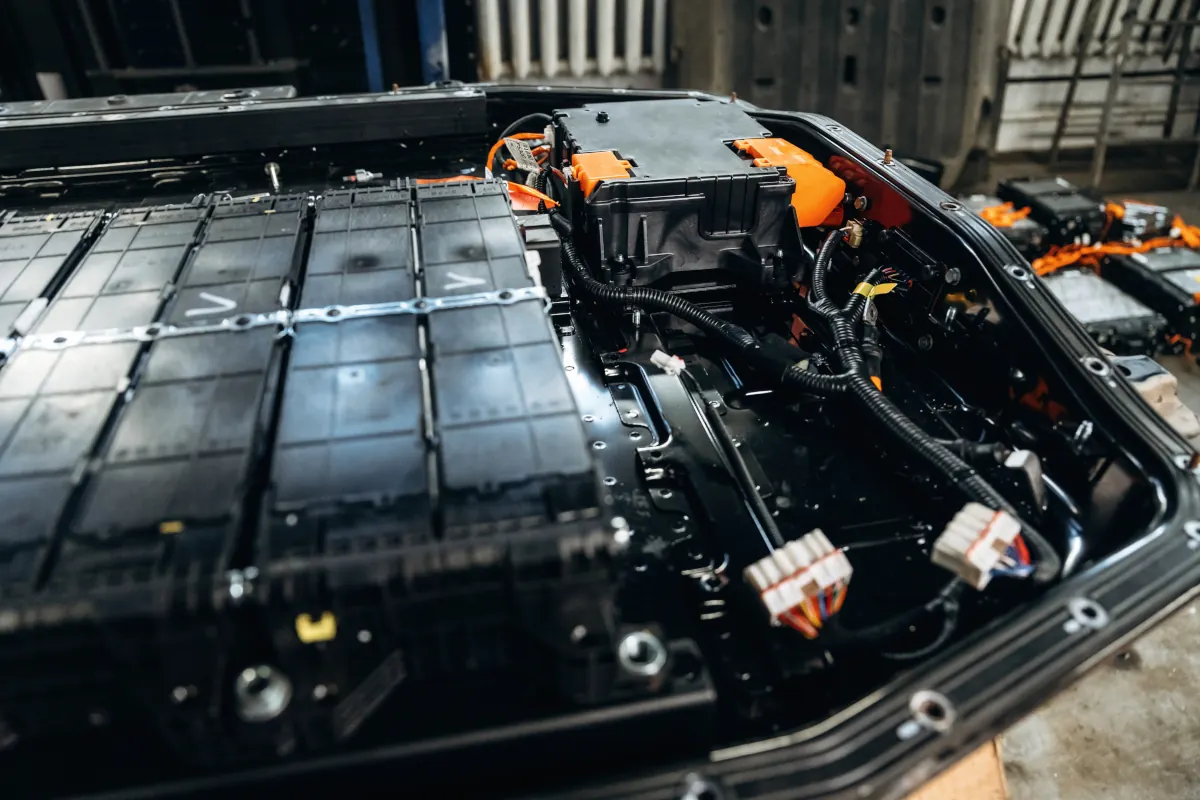
EVs typically carry their battery packs in the floorpan, which means the structure protecting that battery has to meet exacting tolerance specifications after a collision. A floorpan that’s off by even a small margin can compromise the battery enclosure, and that’s not something we’re willing to guess about.
Many EV manufacturers also use high-strength steel and aluminum in combinations you won’t find on a traditional gas vehicle, which changes how the metal responds to frame-straightening equipment. Pulling and measuring these structures back to factory-grade specifications takes more time and more specialized tooling than a conventional repair.
Bottom line: when the battery lives in the floor of the car, structural integrity isn’t optional. It’s the whole reason the calibration and repair process for EV auto body repair looks so different from what most drivers are used to.

The Professional Assessment Process for EV Collision Repair
When an EV arrives at our shop after a collision, the assessment doesn’t start with paint or dents. It starts with a diagnostic scan.
Our technicians run a pre-repair scan to document every fault code and sensor status before touching the vehicle. This gives us a baseline, so we know exactly which systems were affected by the collision and which ones were already flagged before the crash happened.
From there, we assess the structural damage, the battery enclosure, and the specific ADAS components tied to the damaged area. Only after that assessment do we build a repair plan, and that plan almost always includes a line item for post-repair calibration.
Insurance companies often err on the side of caution when structural integrity is questionable, and that caution extends directly to how EV claims get evaluated after a collision.
Equipment and Certification Requirements Behind EV Auto Body Repair
Not every repair facility can perform this work, and that’s a real problem for drivers throughout Sonoma County who assume any body shop can handle an EV the same way it handles a Camry.
The equipment investment alone exceeds $50,000 for a basic calibration setup, and that figure doesn’t include the specialized training, the software subscriptions required for multiple vehicle manufacturers, or the physical space a calibration bay demands. Many general repair shops simply haven’t made that investment.
Our facility carries I-CAR Gold Class certification, which means our technicians maintain current training on evolving EV and ADAS technologies as manufacturers update their systems year over year. When choosing a repair facility for EV auto body repair, always confirm they have in-house calibration capabilities rather than sending the car out to a third party and adding days to your timeline.
OEM Parts and Why They Matter for EV Auto Body Repair
Aftermarket parts have long been an option for drivers looking to save money on a conventional repair, but that calculation changes with EVs.
Roughly 86 percent of parts dollars on battery electric vehicle estimates go toward OEM (original equipment manufacturer) components, compared to 62 percent on gas vehicle estimates. That’s not a coincidence. Sensor mounts, camera housings, and radar brackets often need to match factory specifications exactly, or the calibration simply won’t hold.

We’ve seen cases where an aftermarket bumper looked fine on the outside but wouldn’t allow the parking sensors to calibrate correctly because the mounting points were off by a fraction of an inch. When that happens, the “savings” from the cheaper part disappear fast once you factor in the extra labor to diagnose the problem.
Why Calibration Costs Keep Climbing for EV Auto Body Repair
The share of repairable estimates requiring at least one calibration jumped to 28.3 percent in 2026, up from 21.8 percent the year before. That trend line isn’t slowing down.
As more EVs and mild hybrids reach the road, and as manufacturers add more sensors to each new model year, the number of vehicles needing a calibration after even a minor repair keeps rising. Many Sonoma County drivers are surprised to learn just how many common repairs, including a simple windshield replacement, can trigger the need for recalibration on their EV.
Insurance, Total Loss Decisions, and EV Auto Body Repair Severity
Total loss frequency hit a record 23.1 percent in 2025, and the high cost of repairing advanced technology is a major driver of that number. When calibration, OEM parts, and structural repair costs stack up on an EV claim, an insurer may decide the vehicle is a total loss faster than they would for a comparable gas car.
Insurance companies often err on the side of caution when structural integrity is questionable, particularly when a battery enclosure is involved. That caution can work in the driver’s favor, but it also means EV owners should expect a more thorough claims process than they might be used to.
We handle insurance repairs regularly and can walk you through what an adjuster is likely looking at when they evaluate your EV auto body repair estimate, including which line items relate to calibration and why those costs are non-negotiable for safety reasons.
What to Look for in a Shop That Handles EV Auto Body Repair in Rohnert Park
When you’re comparing repair shops after an EV collision, ask direct questions. Do they own their calibration equipment, or do they sublet that work out? How many EV-specific technician certifications does their team hold? Is there dedicated space for the calibration process itself, since many systems require a controlled environment with specific floor markings and target boards?

When EVs arrive at our auto body repair Rohnert Park facility, baseline costs are substantially higher due to mandatory sensor calibrations.
When you visit our shop, you’ll see why our facility was specifically designed to accommodate these exacting requirements, including adequate calibration space and current I-CAR Gold Class training across our technician team. The goal remains the same on every vehicle that comes through our doors: restore the car to its pre-damage condition, inside and out.
Free Loaner Cars and Support During EV Auto Body Repair
EV auto body repair takes longer than a standard bumper job, largely because of the calibration and parts-sourcing timeline. We understand that being without transportation during repairs can be challenging, which is why we offer free loaner vehicles during repairs, including to Sonoma State University students under 25.
We also take community involvement seriously beyond the loaner fleet. Through our SSU donation program, we return 10 percent of labor costs on qualifying repairs back to Sonoma State University, so a repair at our shop supports the local community in a tangible way.
Conclusion
EV auto body repair in 2026 looks nothing like the collision repair process most drivers grew up with. Between battery safety protocols, structural tolerance requirements, and the sheer number of sensors that need recalibration after even minor damage, the process demands equipment and training that not every shop has invested in.
Final thoughts: if you drive an EV and you’re facing a repair, ask about calibration capabilities before you ask about anything else. The panel gap and the paint match matter, but the calibration is what keeps your car’s safety systems working the way the manufacturer intended.
Frequently Asked Questions
Is EV auto body repair more expensive than fixing a gas car in 2026?
Yes. The average BEV collision claim ran about $6,042 in Q1 2026, compared to $4,902 for a gasoline vehicle, largely due to calibration requirements and higher OEM parts costs.
Do all EV repairs require a calibration?
Not all, but many do. Battery electric vehicles average 1.70 calibrations per repair estimate, and any repair touching a bumper, windshield, mirror, or wheel alignment can trigger the need for one.
Can any body shop perform EV auto body repair?
No. Calibration equipment alone can cost more than $50,000, and shops also need EV-specific technician training and dedicated calibration space, so it’s worth confirming a shop’s in-house capabilities before booking a repair.
Why do EVs get totaled more often than gas cars after a collision?
Total loss frequency hit a record 23.1 percent in 2025, partly because the combined cost of structural repair, OEM parts, and calibration on an EV can push the repair estimate close to the vehicle’s value faster than it would on a comparable gas car.
Does a windshield replacement on an EV really need a calibration?
Often, yes. If your EV’s front camera is mounted to the windshield, replacing that glass shifts the camera’s position enough that the system needs to be recalibrated to millimeter-level accuracy before it’s reliable again.
Should I use aftermarket parts on my EV to save money?
We generally recommend against it for sensor-adjacent components. OEM parts make up about 86 percent of parts dollars on BEV estimates because aftermarket alternatives don’t always allow for a successful calibration.
How do I find a shop that offers proper EV auto body repair near Rohnert Park?
Look for I-CAR Gold Class certification, in-house calibration equipment, and a team that can walk you through the diagnostic scan process before and after the repair. Those details tell you whether a shop is actually equipped for EV auto body repair or just says it is.